Pinocchio
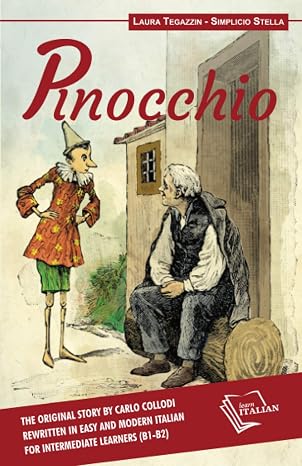
The original story by Carlo Collodi rewritten in simple and modern Italian for intermediate-level Italian students (B1-B2).
by Laura Tegazzin, Simplicio Stella



Everyone knows Pinocchio, but many people don't know the real story. The original book was written by Carlo Lorenzini alias Carlo Collodi. It was published for the first time in 1883 with the title “The adventures of Pinocchio: The Story of a Puppet”.
Since then, many versions have been proposed, especially cinematographic ones, which have modified and softened both the character and the plot.In the original story the world in which Pinocchio lives is merciless and cruel, populated by thieves, murderers and cheaters who will do anything to try to kill or rob. As he grows and matures, Pinocchio must not only learn to defend himself from danger, but also from bullying classmates and from the deception of kind and flattering men.
He also learns not to place too much trust in judges, police and doctors. This may seem excessive to us today, but warning children about the injustices and cruelty of the real world was a feature of children's literature of the 1800s. However, the use of irony and the imaginary characters (puppets, animals, fairies) go a long way towards mitigating the dramatic reality described in the story.
The original book uses 19th-century Italian and is strongly influenced by terms and idioms typical of the Tuscan language. In this edition, the language has been simplified and updated, to adapt it to intermediate level students of Italian.
Who is this book for?
It's for anyone with an intermediate level of Italian knowledge who wants to improve. I would categorize three groups:
- Students attending a regular course who have reached a B1-B2 level. It can also be suitable for advanced beginners (A2) whose mother tongue is a Romance language.
- Foreigners residing in Italy who can already speak fairly well and want to improve their language through reading.
- Individuals of Italian origin living abroad who have some understanding of Italian passed down by their parents or grandparents and want to reconnect with the language of their ancestors.
.
Why Pinocchio?
It's a great classic of Italian literature. Additionally, it's structured in chapters, progressively longer, making it particularly suitable for slower readers. Let's remember that Pinocchio was originally conceived as a series of episodes published in a children's magazine. It later became a book.
However, it's a children's book. Perhaps it's not suitable for an adult audience.
The great success of the work is precisely because it manages to captivate both young readers and adults alike. Children appreciate the fantasy and humor, while adults can grasp elements of strong social criticism.
Almost everyone knows the story of Pinocchio. What interest can it have for a reader?
Everyone knows Pinocchio, but not his true story. Those who haven't read the original book have a different story in mind. The numerous subsequent versions, especially in films, have profoundly altered the character and the plot.
So, is it not worth reading the original then?
The book has been rewritten in modern and simplified Italian, suitable for those who don't have an advanced level of language proficiency. The words and sentence structures have changed significantly in 140 years. An intermediate student would have much more difficulty reading the original book, not to mention the risk of assimilating language that no longer corresponds to current usage. I also discuss this in the book's preface. You can read the preface (back cover) and the introduction in the book's preview. They are written in English, but if you prefer to read in Italian, you can check this page.
In the book, are there comprehension exercises or summaries, like in most student books?
No, there are no exercises, and this was a deliberate choice. To understand the reasons, you need to read that part of the book's introduction that explains the difference between intensive reading and extensive reading. The main objective is the pleasure of reading, a very powerful means to achieve higher levels of knowledge.
Is there any part of the book written in English? Is it aimed at English-speaking students?
No, it is aimed at students of any nationality. English was used as an intermediary language to explain some fundamental concepts and is used only in the preface and introduction. The story and all annotations are in Italian.
How can I determine if the book is suitable for me?
This is also explained in the introduction. The best thing to do is to try reading the chapters available in the preview. It's not important to understand every word. What matters is being able to follow the story and grasp the general meaning. In extensive reading, the main ally is the continuous contextualization of unfamiliar words.
Where can I purchase the book?
The book can be purchased by clicking on the Amazon button. Just click the link provided at the beginning, and you should be directed to the Amazon platform corresponding to your country or the nearest available platform.
How do I read the Kindle format?
You can simply download the software provided for free by Amazon. It's available for iOS, Android, Mac, and PC.
Are there any additional charges that can be added to the list price?
For the Kindle format, there are no additional charges.
For the printed book, in some countries, there may be shipping costs. Typically, in countries with an Amazon website, shipping is free. Even in neighboring countries, shipping can be free. For example, I understand that in Switzerland, even though there isn't a Swiss Amazon site, shipping is free.
In any case, at the time of ordering, Amazon will indicate any potential charges, and you can cancel the order if you wish.